01
Risk perception
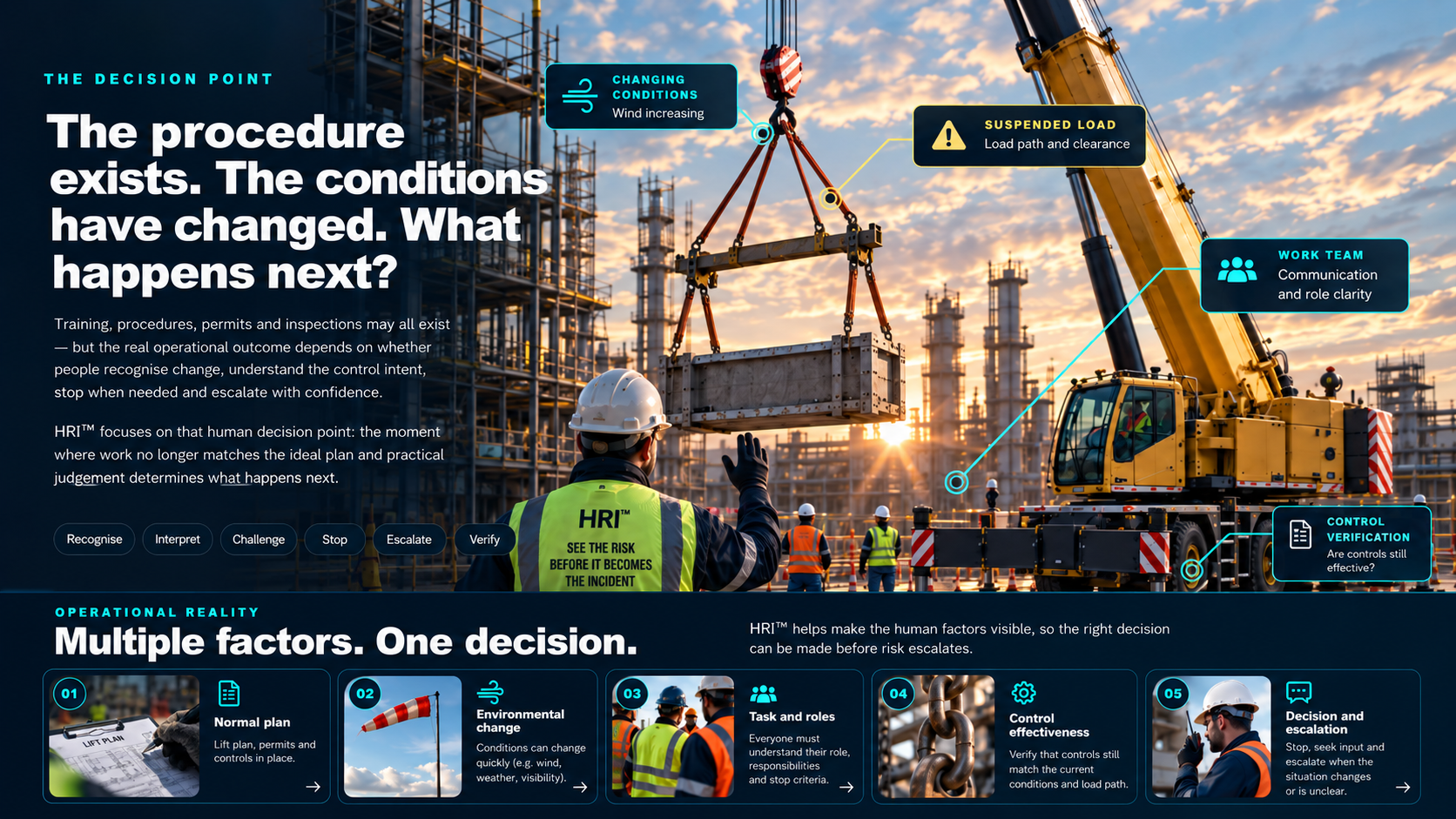
How a person recognises hazards, changing conditions and the significance of what is in front of them.
Human Risk Intelligence™
HRI helps organisations understand how people perceive risk, interpret controls and make safety-critical decisions under real workplace conditions — turning those signals into practical, non-punitive intervention.
Why HRI™
The incident is often the last signal — not the first.
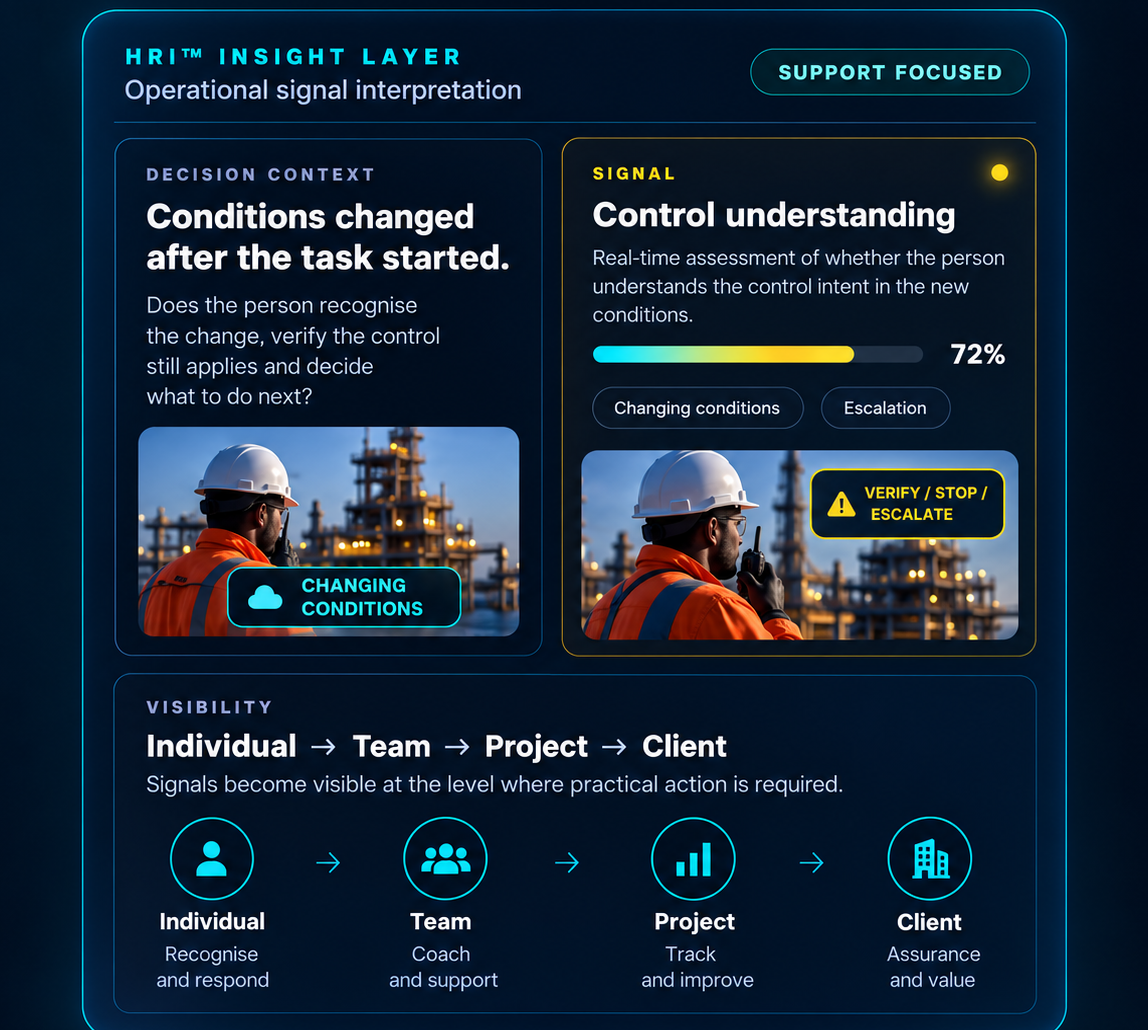
Before harm occurs, signals may already exist in risk perception, control understanding, escalation confidence, task drift and response to change. HRI makes those signals visible early enough to support focused action.
01 · Visible evidence
Training · Procedures · Permits · Inspections
02 · Hidden human signals
Perception · Drift · Understanding · Escalation
03 · Operational action
Coach · Verify · Brief · Intervene · Track
What HRI™ reveals
How a person recognises hazards, changing conditions and the significance of what is in front of them.
Where shortcuts, changed sequences or informal workarounds begin to move away from the intended control.
Whether the purpose, sequence and operating limits of a control are understood in the context of the task.
How confidently a person stops, challenges or seeks support when conditions are unclear or unsafe.
How production, uncertainty, authority and competing priorities can influence the decision point.
Whether new information is recognised early enough to reassess, verify and adapt before work continues.
Research-informed foundation
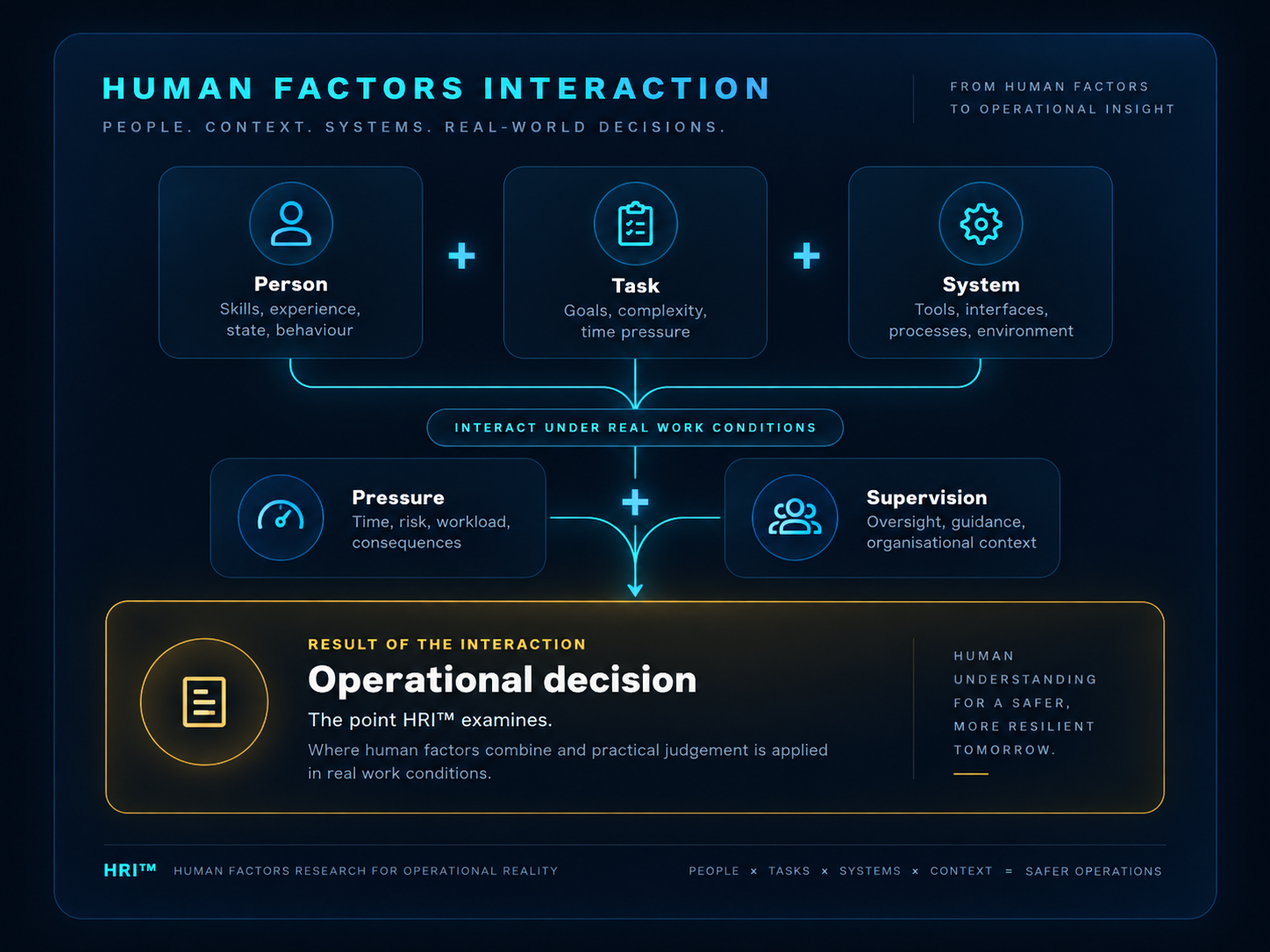
HRI examines the interaction between people, systems, tasks, controls, supervision, pressure and the working environment — then translates that insight into practical operational support.
Platform workflow
HRI turns decision-based assessment into operational signals, practical guidance and a repeatable baseline for targeted improvement.
Participants and project context
Role, level and exposure intelligence
Decision-based assessment
Signals and operational meaning
Coaching, verification and support
Compare change after intervention
HRI™ intelligence architecture
Clients do not need to decode a catalogue of assessments. HRI routes intelligence according to the type of work, level of decision-making and specialist exposure involved.
Workforce & role intelligence
Baseline and role-specific insight for operational work.
SIQ™
Level 1Safety Intelligence
OEI™
Level 1Operator Effectiveness Intelligence
LOI™
Level 1Lifting Operations Intelligence
SEI™
Level 1Scaffold Erection Intelligence
Exposure & specialist intelligence
Additional intelligence for exposure, task and specialist decision contexts.
FRI™
Add-onFall Risk Intelligence
DriftIQ™
SpecialistOperational Drift Intelligence
TWRI™
Multi-roleTemporary Works Risk Intelligence
Supervision & assurance
Decision intelligence for those who direct, verify and assure work.
ODI™
Level 2Operational Decision Intelligence
SSII™
Level 2Scaffold Supervision & Inspection Intelligence
SPI™
ProfessionalSafety Professional Intelligence
Leadership intelligence
Strategic visibility into governance, influence and organisational decision-making.
SRI™
Level 3Strategic Risk Intelligence
Specialist intelligence example
Scenario-based decision intelligence across temporary works supervision, inspection assurance and design — showing how recognition, verification, recovery and reauthorisation decisions develop through changing conditions.
Reports and insight
HRI reports turn assessment signals into plain-language interpretation, reinforcement areas, coaching priorities, supervisor checks and practical intervention guidance.
Individual insight
Focused coaching and verification at participant level.
Aggregate insight
Recurring themes across teams, projects and clients.
HRI™ report
Operational insight summary
Strength
Risk recognition
Coaching
Escalation confidence
Priority
Control verification
Operational focus
Signal profile
Intervention guidance
Verify control intent in the field, reinforce changed-condition escalation and review the signal after focused intervention.
Responsible use
HRI is designed to strengthen supervision, communication, coaching, control verification and organisational learning. Findings should be considered together with relevant task, site and operational evidence.
Not psychometric
Not a personality or psychometric test.
Not clinical
Not a medical or psychological diagnosis.
Not pass/fail
Operational signals are not pass/fail marks.
Not disciplinary
Not a standalone basis for disciplinary action.
Support-focused
Designed for coaching, verification and improvement.
Context matters
Use findings with site, task and operational evidence.
Interested in HRI™?
Discover how HRI can reveal the human-risk signals behind operational decisions and turn them into practical action.